

Mastering the “Health and Safety at Work” component of the NMC CBT is a crucial stepping stone for international nurses. This section doesn’t just evaluate your ability to memorize statutory titles; it actively tests your capacity to link UK legislation with everyday clinical decisions that protect yourself, your colleagues, and your patients.
At Fortuwest International, we ensure you understand the legal underpinnings of UK nursing practice so you can clear your CBT and seamlessly progress toward your OSCE and NHS career. Here is a definitive overview of the vital laws, core duties, and exam-day strategies you need to master this topic.
The Legal Foundation: Health and Safety at Work Act 1974
The Health and Safety at Work etc. Act 1974 is the primary legislation governing workplace safety, welfare, and health across the United Kingdom. For the CBT, you must recognize that this act establishes a system of shared responsibility divided between employers and employees.
Core Duties of the Employer
In a clinical setting (such as an NHS Trust or a private care facility), the employer is legally obligated to construct a safe working ecosystem. This includes:
- Providing and maintaining safe clinical equipment (e.g., hoists, electronic beds).
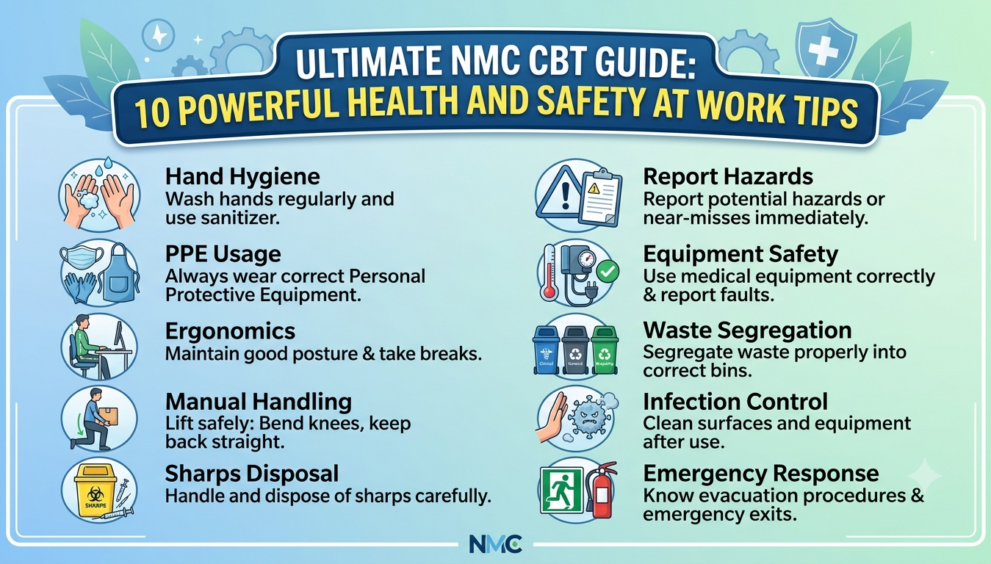
- Providing comprehensive, mandatory training in fire safety, infection control, and manual handling.
- Supplying adequate and appropriate Personal Protective Equipment (PPE).
- Conducting routine clinical environment risk assessments.
Core Duties of the Employee (The Nurse)
A common pitfall on the CBT is assuming safety rests solely on management. Under the 1974 Act, nurses hold strict professional and legal accountability to:
- Take reasonable care of their own health and safety, ensuring they do not perform actions that put others at risk.
- Fully cooperate with local trust safety policies and attend mandatory training updates.
- Correctly use supplied safety equipment and wear appropriate PPE.
- Promptly report and escalate hazards, faulty equipment, near-misses, and adverse clinical incidents.
Core Safety Hotspots Tested on the CBT
Workplace safety questions are frequently embedded within practical clinical scenarios. Keep an eye out for these five core areas:
1. Manual Handling & Patient Moving
- The Rule: Never attempt to manually lift or transfer a patient beyond your physical capabilities or without proper assessment.
- CBT Strategy: The correct answer will almost always prioritize checking the patient’s mobility assessment, securing the correct mechanical aids (like a hoist or slide sheet), and ensuring enough trained staff members are present to assist.
2. Infection Prevention and Control (IPC)
- The Rule: IPC is both a patient safety mandate and a personal protection requirement.
- CBT Strategy: Focus on the immediate correct sequence of hand hygiene, proper disposal of clinical waste, sharps safety protocols, and post-exposure prophylaxis (PEP) pathways if a needlestick injury occurs.
3. Risk Assessment & Environmental Awareness
- The Rule: Nurses must continuously identify everyday clinical hazards—such as wet corridors, blocked fire exits, or overloaded electrical sockets.
- CBT Strategy: Immediate action must be taken to minimize the risk (e.g., clearing a blocked fire exit if safe to do so) followed by formal local reporting.
4. Handling Hazardous Substances
- The Rule: Healthcare environments involve regular exposure to chemical disinfectants, specialized medications, and bodily fluids.
- CBT Strategy: Ensure you follow standard protocols regarding safe storage, clear container labeling, and wearing specialized PPE when handling cytotoxic drugs or chemical agents.
5. Incident and Near-Miss Reporting
- The Rule: Under the NMC Code and UK health laws, documenting an error or near-miss is vital for organizational learning.
- CBT Strategy: Look for options that emphasize immediate patient safety checks, followed by formal recording via the trust’s electronic incident reporting system.
5 High-Yield CBT Practice Questions
Test your clinical judgment with these exam-style questions:
Question 1
A nurse observes that a corridor fire exit is partially obstructed by a stack of stored clinical equipment. What is the most appropriate first action?
- A. Leave it alone as the ward clerk will likely move it later.
- B. Move the equipment immediately if it is safe to do so and report the hazard.
- C. Postpone action until the shift coordinator arrives the next morning.
- D. Tape a warning note on the wall adjacent to the equipment.
Rationale: Fire exits must remain entirely unobstructed at all times. A safe nurse eliminates the immediate hazard if safe and escalates it per protocol.
Question 2
Which statement accurately defines a nurse’s legal obligation under the Health and Safety at Work Act 1974?
- A. Nurses are strictly responsible for their own personal protection.
- B. Nurses must take reasonable care for the safety of themselves and any others affected by their actions.
- C. Experienced nurses are exempt from local trust mandatory training updates.
- D. Nurses may bypass clinical safety policies if they conflict with shift efficiency.
Rationale: The law explicitly mandates that employees must maintain a duty of care for both themselves and any individuals (colleagues, patients, visitors) affected by their work.
Question 3
A colleague asks you to assist in manually lifting a non-weight-bearing patient from a bed to a wheelchair without using a hoist. What is the safest response?
- A. Agree to assist immediately to save time for the patient.
- B. Refuse the request and leave the patient unattended in bed.
- C. Decline the manual lift, assess the patient’s mobility plan, and secure the appropriate hoist and team support.
- D. Guide the patient to stand independently without any external support.
Rationale: Ergonomic safety requires proper risk assessment and utilizing mechanical handling aids to prevent musculoskeletal injuries to both staff and patients.
Question 4
A nurse sustains a needlestick injury from a used syringe during a busy medication round. What action should be prioritized first?
- A. Complete the remaining patient medication administrations before addressing the injury.
- B. Bleed the wound under running water, wash with soap, and immediately activate the post-exposure protocol.
- C. Discard the syringe in the sharps bin and monitor the finger over the next few days.
- D. Ask a fellow staff nurse if formal reporting is necessary for clean needles.
Rationale: Immediate first aid and prompt reporting are vital to access early post-exposure prophylaxis and ensure safety compliance.
Question 5
Which of the following actions constitutes a primary duty of care for a healthcare employer?
- A. Ensuring the provision of fully maintained, safe equipment alongside necessary training.
- B. Overlooking minor environmental hazards during high-occupancy shifts.
- C. Allowing clinical staff to decide individually whether to utilize standard PPE.
- D. Mandating that newly hired international nurses learn clinical skills solely via observation.
Rationale: Employers hold the statutory responsibility to provide safe systems of work, operational equipment, and structured clinical training.
The Fortuwest International Strategic Framework
When tackling complex health and safety scenario questions on your CBT exam day, follow this structured, 4-step decision-making hierarchy to consistently arrive at the correct answer:
[1. Identify the Immediate Hazard]
               │
               ▼
[2. Take Action to Protect Life & Minimize Risk Safely]
               │
               ▼
[3. Escalate/Seek Assistance if Outside Competence]
               │
               ▼
[4. Document and Formally Report the Incident]
Conquer Your NMC CBT with Fortuwest International
Preparing for the NMC CBT involves learning how to apply the clinical standards expected of a UK Registered Nurse. At Fortuwest International, we simplify your revision with extensive question banks, interactive study guides, and expert mentorship.
Let us help you navigate your CBT, OET, and OSCE preparation smoothly. Reach out to Fortuwest International today to launch your UK career journey.
Lorem ipsum dolor sit amet, consectetur adipiscing elit. Ut elit tellus, luctus nec ullamcorper mattis, pulvinar dapibus leo.