

If you trained as a nurse outside the United States and you’re staring down the NCLEX-RN, you’ve probably already heard two things that don’t quite match up: that the exam is more “fair” now because of a new format, and that internationally educated nurses are still failing at far higher rates than U.S.-trained graduates. Both are true. Understanding why — and what to actually do about it — is the difference between passing on your first attempt and joining the growing pool of repeat test-takers.
The Next Generation NCLEX, in Plain Terms
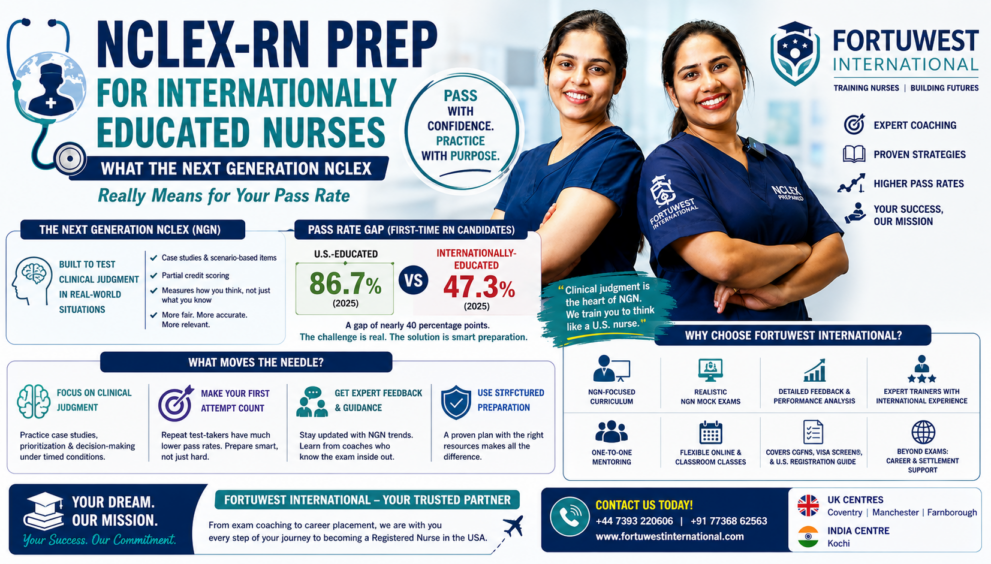
The Next Generation NCLEX (NGN) launched on April 1, 2023, replacing the older exam structure for both RN and PN candidates. <cite index=”31-1″>Both versions now run 85 to 150 items with a five-hour time limit, retiring the previous 75–145 item range for the RN exam</cite>. The redesign wasn’t cosmetic — it was built to test something the old exam couldn’t reliably measure: clinical judgment under realistic, case-based conditions.
Two changes matter most for international candidates:
- Case studies and scenario-based items now sit alongside traditional multiple-choice questions, requiring you to reason through a patient situation the way you would on a real ward, not just recall a fact.
- Partial-credit scoring on multi-response and case-study items means you can earn credit for a partially correct answer instead of losing everything for one wrong selection. <cite index=”33-1″>This partial-credit mechanism is a major reason first-time, U.S.-educated RN pass rates jumped from 79.9% in 2022 to 88.6% in 2023 and 91.2% in 2024</cite>.
The Pass Rate Gap Nobody Talks About Enough
Here’s where the picture gets more complicated. While U.S.-educated first-time candidates initially benefited from the NGN format, that same boost hasn’t shown up nearly as strongly for internationally educated nurses — and the gap between the two groups has actually widened in places.
<cite index=”33-1″>First-time, U.S.-educated RN pass rates fell from 91.2% in 2024 to 86.7% in 2025, while the first-time, internationally-educated RN rate dropped even further, from 53.8% to 47.3% over the same period</cite>. Put another way: <cite index=”34-1″>internationally educated candidates as a group have posted an overall pass rate around 53.8%, compared to roughly 91% for U.S.-educated nurses — a gap of nearly 40 percentage points</cite>.
The picture has improved somewhat more recently. <cite index=”29-1″>RN candidates overall passed at a 74.4% rate in the first half of 2026, already exceeding the full 2025 rate, following a dip to 69.1% in 2025</cite>. But the recovery hasn’t been shared equally — <cite index=”29-1″>internationally educated repeat candidates remained the weakest-performing group, passing at just 31.7% in the first half of 2026</cite>, and <cite index=”31-1″>first-time internationally educated candidates were passing at roughly 51.6% in Q1 2026, still 35 to 40 points behind their U.S.-educated peers</cite>.
Why the persistent gap? It isn’t a knowledge problem. <cite index=”28-1″>Analysts point to curriculum differences between international nursing programs and the U.S.-style clinical reasoning the NGN tests, along with heightened test anxiety among candidates navigating an unfamiliar exam in a second working language</cite>. In short: the NGN rewards a very specific way of thinking through a patient scenario, and if you were never trained to think that way, no amount of content knowledge alone will close the gap.
What Actually Moves the Needle
If you’re preparing for the NCLEX-RN as an internationally educated nurse, generic content review isn’t enough. Here’s what the data suggests actually helps:
1. Train specifically for clinical judgment items, not just facts. The NGN’s case studies test prioritization, recognizing cues, and generating solutions — skills that traditional multiple-choice-heavy study guides don’t build. Practising full case studies under timed conditions matters more than memorising drug lists.
2. Take the “first attempt” seriously — it’s not a dry run. Repeat test-takers pass at dramatically lower rates than first-timers — in 2025, U.S.-educated repeat candidates passed at only 52.7%, and the gap is even steeper for international repeat candidates. Walking in underprepared to “see what it’s like” is a costly strategy; treat your first sitting as the one that counts.
3. Get feedback from people who’ve coached candidates through the NGN specifically. Because the exam format is still relatively new (2023 onward) and pass-rate data keeps shifting year to year, prep material that hasn’t been updated for the current NGN structure can actively work against you.
Why a Structured Program Matters More Than Self-Study Alone
Given the size of the gap between self-guided study and structured, exam-specific coaching, more internationally educated nurses are turning to dedicated training partners rather than trying to piece together a study plan from outdated guides and forum advice.
Fortuwest International has built its reputation coaching internationally educated nurses through the full stack of overseas licensing exams — not just the NCLEX-RN, but the OET, IELTS, CBT, and NMC OSCE that many candidates are juggling at the same time on the UK pathway. That breadth matters: Fortuwest’s coaching model is built around one-on-one attention, mock exams, and detailed feedback tailored to where each candidate is actually struggling, rather than a one-size-fits-all course. For nurses balancing a full-time job, family responsibilities, and multiple licensing exams at once — which describes most internationally educated candidates — that individualized structure is often what turns repeated near-misses into a first-time pass.
Beyond exam coaching, Fortuwest also supports candidates with the practical side of the journey many prep courses ignore: overseas education consultancy, career guidance, and placement and settlement support once you’ve passed. For a candidate managing NCLEX prep alongside visa paperwork, credential evaluation, and relocation logistics, having one partner who understands the whole pathway — not just the test — removes a significant amount of the friction that derails otherwise well-prepared nurses.
Key Takeaways
- The NGN format rewards clinical reasoning and offers partial credit — genuinely different from the old exam, and worth training for specifically.
- Internationally educated nurses still face a substantial pass-rate gap compared to U.S.-educated candidates, and that gap has not closed uniformly since the NGN launched.
- Repeat test-takers, especially international repeat candidates, face the steepest odds — first-attempt preparation quality matters enormously.
- Structured, exam-specific coaching — like the programs offered through Fortuwest International — consistently outperforms generic self-study, particularly for candidates managing multiple licensing exams and relocation logistics at once.
The NCLEX-RN gap facing international nurses is real, well-documented, and not a reflection of clinical ability. With the right preparation strategy — one built around how the NGN actually tests judgement, not just knowledge — it’s a gap that’s very possible to close.