


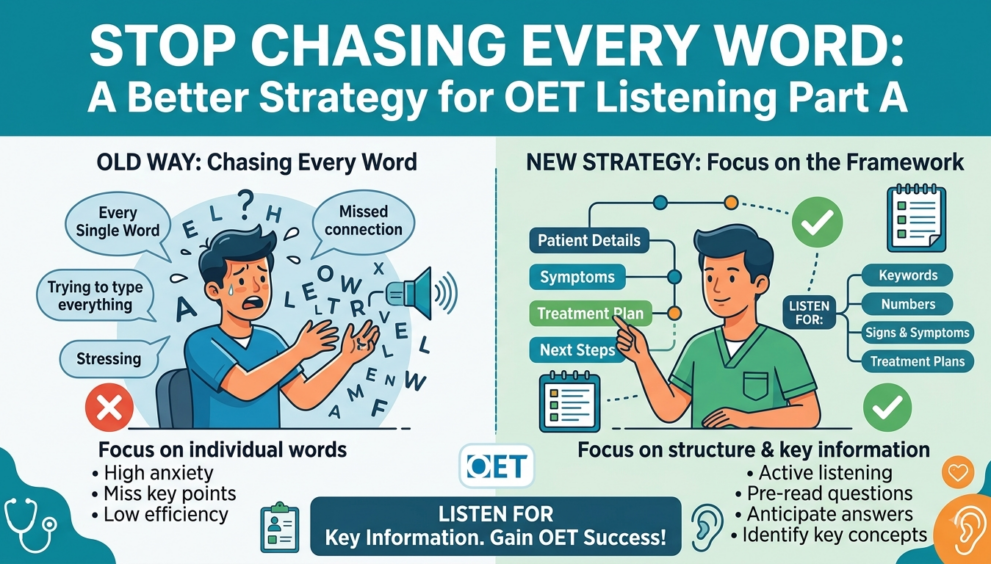
Have you ever completed an OET Listening Part A practice test and thought, “I heard the conversation, but I still missed the answer?”
This is a common experience for many OET candidates.
The problem is not always a lack of listening ability. Sometimes, candidates simply try to focus on too much information at once. In OET Listening Part A, the conversations contain many details, but only some of those details are needed to complete the notes.
The key is learning how to identify the right information.
Instead of trying to catch every sentence, train yourself to recognise keywords, answer patterns, and changes in wording. This can help you follow the consultation more effectively and respond with greater confidence.
Turn Preparation Time into an Advantage
Before the recording starts, you are given time to read the notes and questions.
Don’t use this time just to read quickly from beginning to end. Look carefully at each incomplete note and identify the words that tell you what information is required.
Pay attention to clues related to:
- Symptoms and medical conditions
- Medication and treatment
- Parts of the body
- Dates and durations
- Numbers and measurements
- Frequency
- Investigations
- Actions or activities
For example:
Pain increased after ______.
The word after is an important clue. It suggests that you may hear an event, activity, or action connected with the increase in pain.
Your task is to prepare your attention before the consultation begins.
Ask: What Am I Listening For?
A useful habit is to predict the category of the answer.
Consider this note:
Taking medication ______ times a day.
You can immediately expect a frequency or number.
Now consider:
Referred for ______.
You may be listening for an investigation, treatment, specialist, or healthcare service.
You don’t need to guess the exact answer. Predicting the answer category is enough to help you recognise relevant information when it appears.
This prevents your attention from becoming distracted by every other detail in the consultation.
Watch Out for Different Wording
OET Listening Part A may communicate information using words that are different from those written in the notes.
For instance, a question might say:
Pain became worse ______.
The speaker may say:
“It started getting more severe after I went for a long walk.”
The words became worse and started getting more severe are not identical, but the meaning is closely connected.
This is why listening for meaning is more effective than waiting for an exact word match.
As you practise, start building awareness of common alternatives. Words such as started, developed, noticed, and experienced may all introduce information about symptoms or changes.
The more familiar you become with paraphrasing, the easier it can be to follow the conversation.
Don’t Write More Than You Need
Sometimes candidates hear the correct information but lose accuracy by writing a complete phrase when only a few words are required.
Imagine the note says:
Duration of symptoms: ______
If the patient says:
“I’ve been experiencing them for around two weeks.”
The required answer may simply be:
two weeks
Writing unnecessary words can make the answer less clear and may create spelling or grammar mistakes.
Keep your response focused on what completes the note correctly and always follow the instructions given in the test.
Let the Notes Guide You
The structure of the notes can provide useful information.
For example:
Previous surgery: ______
The answer should logically identify a procedure or relevant medical information.
Or:
Pain level: ______ /10
The format clearly tells you that a numerical answer is expected.
A quick check of grammar and meaning can help you decide whether your answer fits naturally.
Mistakes That Can Cost Valuable Marks
Even candidates with strong English skills can make avoidable mistakes.
Try to avoid:
- Listening to every word with equal attention.
- Ignoring important words in the question.
- Waiting for an exact word instead of listening for meaning.
- Writing long answers when short answers are required.
- Adding information that was not stated in the recording.
- Forgetting to check spelling and grammar.
- Losing focus after missing one answer.
If you miss something, stay calm and continue following the recording. Focusing on the next section may help you avoid losing further answers.
Build the Skill Through Focused Practice
Practice becomes more useful when you analyse your mistakes.
After completing an OET Listening Part A exercise, review the questions and identify:
- Which words acted as the main clues?
- What type of answer was required?
- Did the speaker use the same words or a paraphrase?
- Did your answer fit naturally into the notes?
- Did you include unnecessary words?
This approach can help transform practice tests into learning opportunities.
The Goal Is Smart Listening
Success in OET Listening Part A is not about remembering every sentence you hear.
It is about recognising where the important information is likely to appear and understanding how that information may be expressed.
Train yourself to read the clues before the recording, predict the type of answer, listen for meaning, and keep your responses clear and concise.
The next time you practise, remember:
Don’t chase every word. Follow the clues and listen for the information that matters.
Prepare for Your International Career Journey
Fortu West International supports students and healthcare professionals who are preparing for international education and career opportunities. With the right guidance and a focused preparation strategy, you can take your next step with greater confidence.
Start preparing with purpose and move closer to your international goals.