


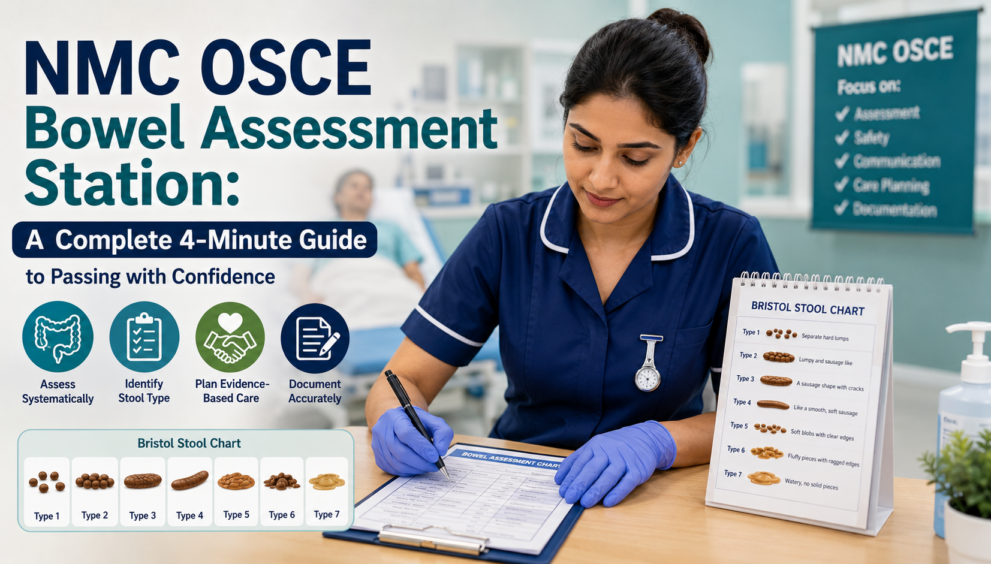
The Bowel Assessment Station is an 8-minute silent assessment in the NMC OSCE that evaluates your ability to perform a structured bowel assessment, complete the Bristol Stool Chart accurately, and recommend safe, evidence-based nursing care.
Many candidates believe identifying the correct Bristol Stool Type is enough to pass. In reality, examiners also assess your clinical reasoning, documentation skills, and ability to develop an appropriate patient-centred plan of care.
This guide highlights exactly what you need to know to maximise your marks.
What Does the Examiner Assess?
The station focuses on four key areas:
- Correctly identifying the Bristol Stool Type
- Completing the Bristol Stool Chart accurately
- Maintaining professional documentation standards
- Recommending an appropriate nursing care plan
Success depends on demonstrating safe nursing practice—not simply recognising stool types.
Accurate Documentation Matters
Always ensure you:
- Record the correct Bristol Stool Type
- Complete all required sections of the assessment chart
- Add the correct date and time
- Sign your documentation
- Write clearly and legibly
- Correct mistakes using a single strike-through
Incomplete or unclear documentation can result in unnecessary loss of marks.
Constipation (Bristol Stool Types 1 & 2)
Types 1 and 2 indicate constipation.
The examiner expects more than simply stating the patient is constipated. You should recommend several evidence-based nursing interventions.
Appropriate Nursing Care
Consider including the following:
- Assess possible causes such as opioid medication, iron tablets, dehydration, poor diet, reduced mobility, neurological disorders, or recent surgery.
- Encourage a high-fibre diet including fruits, vegetables, whole grains, cereals, and pulses.
- Promote adequate fluid intake unless contraindicated.
- Encourage regular physical activity appropriate to the patient’s condition.
- Discuss prescribed laxatives where clinically indicated.
- Encourage patients to respond promptly to the urge to defecate.
- Promote healthy toileting habits by ensuring privacy, comfort, and sufficient time.
- Continue monitoring bowel frequency, stool consistency, and response to treatment.
Aim to document at least five appropriate interventions.
Diarrhoea (Bristol Stool Types 6 & 7)
Types 6 and 7 represent loose or watery stools.
Candidates should recognise potential causes before planning care.
Possible Causes
These may include:
- Food poisoning
- Antibiotic-associated diarrhoea
- Overflow diarrhoea
- Norovirus
- Clostridioides difficile infection
- Healthcare-associated infections
- Malabsorption disorders
Appropriate Nursing Care for Diarrhoea
Recommended interventions include:
- Follow infection prevention and control procedures, including isolation if required.
- Encourage adequate hydration and monitor for signs of dehydration.
- Send stool samples if indicated according to local policy.
- Provide appropriate dietary advice while symptoms continue.
- Review prescribed medications where appropriate.
- Assess perianal skin integrity regularly.
- Ensure easy toilet access while maintaining privacy and dignity.
- Continue monitoring stool frequency, consistency, fluid balance, and patient response.
Again, aim to include at least five nursing interventions.
Common Mistakes That Cost Marks
Many candidates lose marks because they:
- Identify the stool type but fail to recommend appropriate care
- Forget hydration advice
- Omit infection control measures in diarrhoea cases
- Fail to continue bowel monitoring
- Forget to sign or date documentation
- Record the wrong stool type
- Produce unclear or incomplete documentation
Avoiding these common errors can significantly improve your OSCE performance.
Quick Checklist Before You Finish
Before submitting your documentation, ask yourself:
- Have I identified the correct Bristol Stool Type?
- Have I completed the chart correctly?
- Have I signed, dated, and timed my documentation?
- Have I recommended at least five appropriate nursing interventions?
- Have I considered possible causes?
- Have I included ongoing monitoring and patient education?
If you can confidently answer “Yes” to each question, you are demonstrating the standard expected of a registered nurse.
Final Tips for Success
The NMC OSCE Bowel Assessment Station is designed to assess your ability to think critically and deliver safe, patient-centred care.
Remember to:
- Assess systematically
- Document accurately
- Identify possible causes
- Recommend evidence-based interventions
- Continue ongoing assessment and evaluation
By combining sound clinical reasoning with professional documentation, you’ll greatly improve your chances of achieving full marks in this station.
Prepare for Your NMC OSCE with Fortuwest International
Whether you’re preparing for your first NMC OSCE attempt or looking to strengthen your clinical skills, Fortuwest International provides expert guidance, practical preparation, and personalised support to help international nurses succeed with confidence.
Start your OSCE journey with Fortuwest International today and move one step closer to becoming a UK-registered nurse.